HIGHEST QUALITY STANDARD

SCIENTIFICALLY SUPPORTED FORMULAS BY NUTRITIONISTS

MADE IN SLOVENIA

NATURALLY LACTOSE-FREE

NATURALLY GLUTEN-FREE

NO ADDED SUGAR

GMO FREE

100% VEGAN
New website, fresh look and improved formulations. Discover new products and boost your well-being. Shop
HIGHEST QUALITY STANDARD
SCIENTIFICALLY SUPPORTED FORMULAS BY NUTRITIONISTS
MADE IN SLOVENIA
NATURALLY LACTOSE-FREE
NATURALLY GLUTEN-FREE
NO ADDED SUGAR
GMO FREE
100% VEGAN
SCIENTIFICALLY SUPPORTED FORMULAS BY NUTRITIONISTS
HIGHEST QUALITY STANDARD
NO ADDED SUGAR
NATURALLY GLUTEN-FREE
NATURALLY LACTOSE-FREE
MADE IN SLOVENIA
100% VEGAN
GMO FREE

HIGHEST QUALITY STANDARD
SCIENTIFICALLY SUPPORTED FORMULAS BY NUTRITIONISTS
MADE IN SLOVENIA
NATURALLY LACTOSE-FREE
NATURALLY GLUTEN-FREE
NO ADDED SUGAR
GMO FREE
100% VEGAN
SCIENTIFICALLY SUPPORTED FORMULAS BY NUTRITIONISTS
HIGHEST QUALITY STANDARD
NO ADDED SUGAR
NATURALLY GLUTEN-FREE
NATURALLY LACTOSE-FREE
MADE IN SLOVENIA
100% VEGAN
GMO FREE

ISO 22000, GMP, and HACCP are key standards for ensuring the safety and quality of food and dietary supplements. ISO 22000 establishes a comprehensive food safety management system, GMP ensures consistent quality in production, and HACCP is based on identifying and controlling risks.
ISO 22000 is an international standard that specifies the requirements for a food safety management system. Its main goal is to establish a reliable framework for preventing hazards throughout the food chain and ensuring food safety for end consumers. The standard combines the principles of a quality management system (e.g., ISO 9001) with the principles of a hazard analysis and critical control points (HACCP) system.
Key features of ISO 22000 include:
ISO 22000 is intended for organizations that want to ensure the highest level of food safety, meet legal requirements, and build consumer trust.
GMP (Good Manufacturing Practice) are guidelines that regulate the production, storage, and distribution of dietary supplements and other products that affect human health.
For dietary supplements, GMP ensures:
Compliance with GMP means operating according to the strictest regulatory requirements and greater customer confidence.
HACCP (Hazard Analysis and Critical Control Points) is a preventive system for identifying, evaluating, and controlling risks associated with food safety.
Key steps of HACCP:
HACCP is the foundation of ISO 22000 and GMP, as it enables structured and verifiable control over food safety.
Why are these standards important?
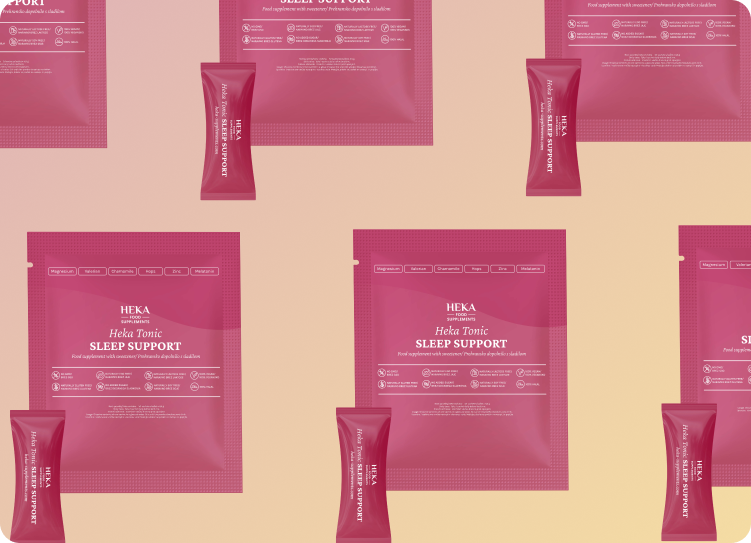
A drink containing carefully selected ingredients to support your body and mind before sleep. HEKA Tonic – Sleep Support helps improve sleep quality, shorten the time it takes to fall asleep, and contributes…

We are sure that among the tips for 5 refreshing summer smoothies, you will definitely find one that will give you a new idea for a summer refreshment!

Do you ever feel like your 'batteries are empty'? Do you struggle to resist the snooze button in the morning? Do you sometimes feel like you just can't wake up? If you answered…

Become part of the inner circle and be among those who receive the best inside information.
Heka Food Supplements © | WPM d.o.o.
No products in the cart.